The private vs shared game drive question in the Masai Mara comes down to one variable: how much control matters to you, and what you are prepared to spend for it. Both options deliver genuine wildlife viewing. Both can produce extraordinary sightings. What differs is the experience on the vehicle itself, including the pace, the positioning, the people around you, and who decides when to leave a sighting. This guide breaks down the real differences so you can make the call that fits your trip.
What Is a Private Game Drive?
A private game drive means the vehicle is exclusively yours. Your travel group, and no one else, occupies it. The guide works solely for you. Stops, sighting time, and vehicle positioning are all decided by your group in consultation with the guide.
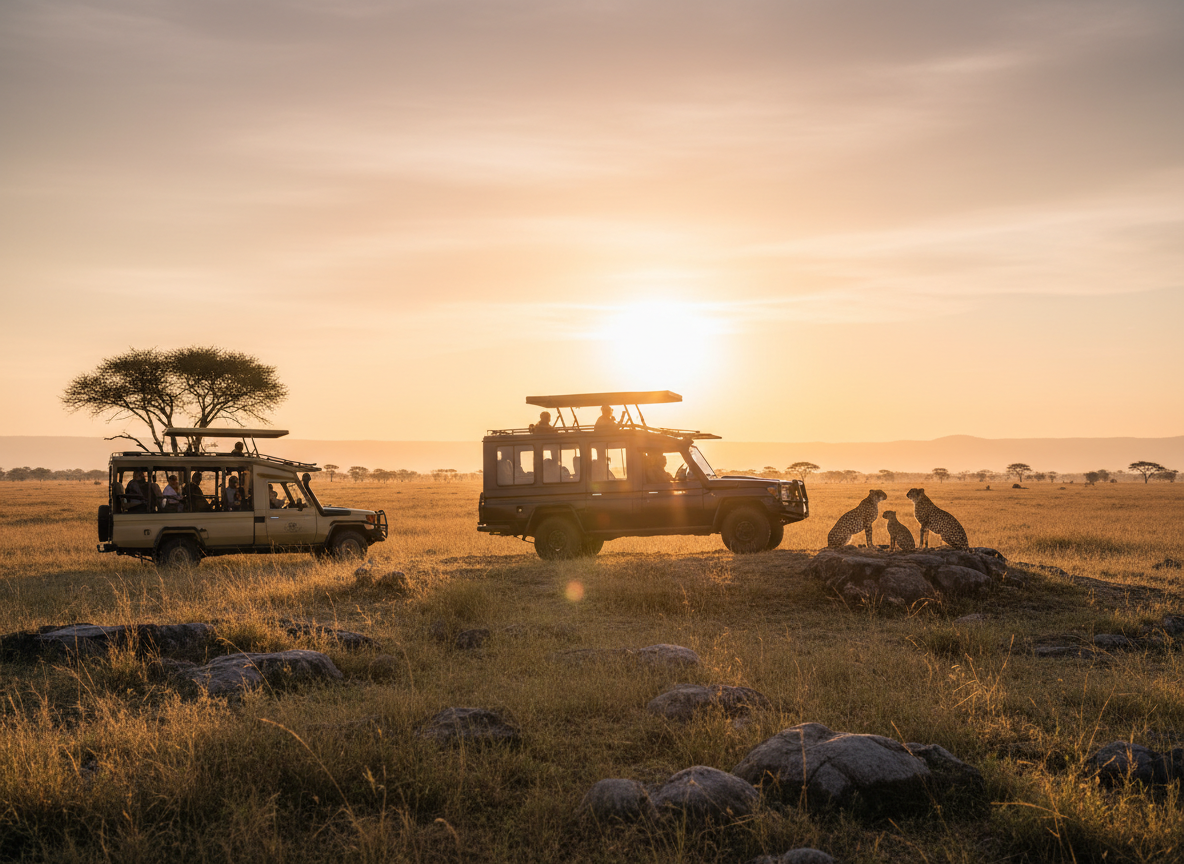
Private vehicles in the Masai Mara are typically 4×4 pop-top Land Cruisers or Land Rovers, accommodating 2 to 6 guests. The schedule is yours: when to depart camp, how long to stay at a lion sighting, and when to head back.
What Is a Shared Game Drive?
A shared game drive places you in a vehicle alongside other guests who are not part of your travel party. Vehicles typically carry 6 to 8 guests total, often from different countries with different wildlife priorities.
Shared drives operate on fixed schedules. Departure and return times are set in advance. Decisions about how long to stay at a sighting, which direction to take, and when to move on rest with the guide, who is balancing multiple preferences at once.
Most budget and mid-range Masai Mara camps offer shared game drives as their default included option. Private drives are usually available as an upgrade or a separate booking.
Private vs Shared Game Drive: How They Compare
| Factor | Private Game Drive | Shared Game Drive |
|---|---|---|
| Who is in the vehicle | Your group only | Mixed guests from different parties |
| Schedule | Fully flexible | Fixed departure and return |
| Time at each sighting | As long as your group wants | Guide decision, balanced across guests |
| Off-road positioning | Your call | Guide decision |
| Photography positioning | Optimised for your lens and angle | Balanced across all passengers |
| Wildlife wait time | Can hold one sighting for 2+ hours | Typically moves on sooner |
| Drive pace | Slow and focused, or broad, your choice | Usually broader coverage |
| Guide attention | Entirely on your group | Shared across all guests |
| Cost | Higher | Lower |
The Case for a Private Game Drive
Positioning control
This is the most underrated advantage of the private format. A private guide can swing the vehicle to put the right light on a leopard, position you on the upstream side of a Mara River crossing, or pull back from a lion pride to give your lens a wider frame. In a shared vehicle, positioning is always a negotiation between competing needs.
Time at sightings
One of the most common frustrations on shared drives is leaving a great sighting too early because the group is restless or the schedule is tightening. With a private vehicle, you can hold a cheetah and cubs for 90 minutes, watch a kill unfold from start to finish, or sit with a family of elephants until the late afternoon light is exactly right. That patience is what separates good sightings from the ones people recount for years.
Tailored focus
A solo birdwatcher, a photographer using a 600mm lens, and a family with young children have little in common as passengers on a game drive. A private vehicle adapts entirely to whoever is in it. The guide learns your interests quickly and structures the drive around them. There is no negotiation, no compromise, and no pressure to move on.
Quiet
A private vehicle is quiet. No side conversations from other guests, no commentary about wanting to go somewhere else. Wildlife observation is fundamentally a patient, quiet activity. A private vehicle protects that quality in a way a shared one cannot.
The Case for a Shared Game Drive
Cost
Shared drives are typically 30 to 60 percent cheaper than equivalent private drives. For travelers stretching a budget across multiple parks, or directing funds toward a balloon flight or an upgraded camp, this saving is meaningful.
Social value
Solo travelers and couples who enjoy meeting people often find that a shared vehicle becomes one of the more memorable parts of the trip. Sharing a lion sighting with strangers who immediately become companions is an experience in its own right. Travelers who appreciate that social texture report the shared format as genuinely rewarding.
Built-in structure
Shared drives follow routes and timings the guide has refined through experience. That structure suits travelers who prefer not to make routing decisions themselves. You show up, the guide handles it, and the drive unfolds without requiring any input from you about where to go next.
Private Game Drive Cost in the Masai Mara
Pricing varies by operator, season, and duration:
- Half-day private game drive (3 to 4 hours): $120 to $200 per vehicle
- Full-day private game drive with a bush lunch: $250 to $400 per vehicle
- Private conservancy camps: private drives are usually included in all-inclusive rates
Shared drives at budget camps are commonly built into the camp rate. At mid-range properties, shared drives typically cost $40 to $80 per person per outing.
An important note for couples: when two people split the cost of a private vehicle, the per-person price often comes close to what a shared drive costs at a mid-range or premium camp. The upgrade is more accessible than most travelers expect when they first see the vehicle price.
Who Should Choose Private, and Who Should Choose Shared?
Private game drives suit:
- Photographers: positioning, timing, and silence are non-negotiable when shooting with long lenses or waiting for specific behavior
- Honeymoon and romance travel: intimacy and uninterrupted moments are not possible in a shared vehicle
- Wildlife behavior watchers: seeing a hunt, a courtship display, or a kill unfold completely requires the freedom to stay put for as long as it takes
- Families with young children: private pacing lets you take breaks when needed, explain things at a child’s level, and tolerate noise without disrupting other guests
Shared game drives suit:
- Budget-conscious travelers who are not photography-focused
- Solo travelers who want company during the drive
- Travelers who prefer a structured experience without making their own routing decisions
Explorer Notes
A few practical points worth confirming before you book.
If you are visiting a private conservancy rather than the national reserve, check whether your camp’s all-inclusive rate already covers private drives. Many conservancy properties include them as standard, which significantly changes the cost comparison.
Shared drives typically run at standard wildlife hours: early morning departures around 6:00 to 6:30 AM and afternoon drives from around 4:00 PM. Private drives allow you to shift those windows based on conditions, light, and what you found the previous morning.
Photography travelers should check the vehicle configuration before committing. Some shared vehicles seat all guests on a continuous bench, which limits lens angle and range of motion. Purpose-built photography vehicles with individual swivel seats and armrests exist, but they are almost always booked as private.
In peak season, roughly July through October when the Great Migration is in the Mara, demand for private vehicles is high across all quality camps. Book early if you want both your preferred property and a confirmed private vehicle on the dates you need.
The Decision
Neither format is universally better. The private vs shared game drive comparison in the Masai Mara comes down to what you are there to do. If pace, positioning, and patience at sightings matter to you, a private vehicle is worth the difference in cost. If you are traveling solo, watching a budget, or simply want a structured morning in the bush without the decisions, a shared drive gives you genuine wildlife viewing at a fraction of the price.
Both options can produce remarkable mornings. The difference is in who controls the experience.
If this guide has you ready to travel, a safari specialist can handle the route, camps, and logistics end to end.
Want to Book a Tour With Us?